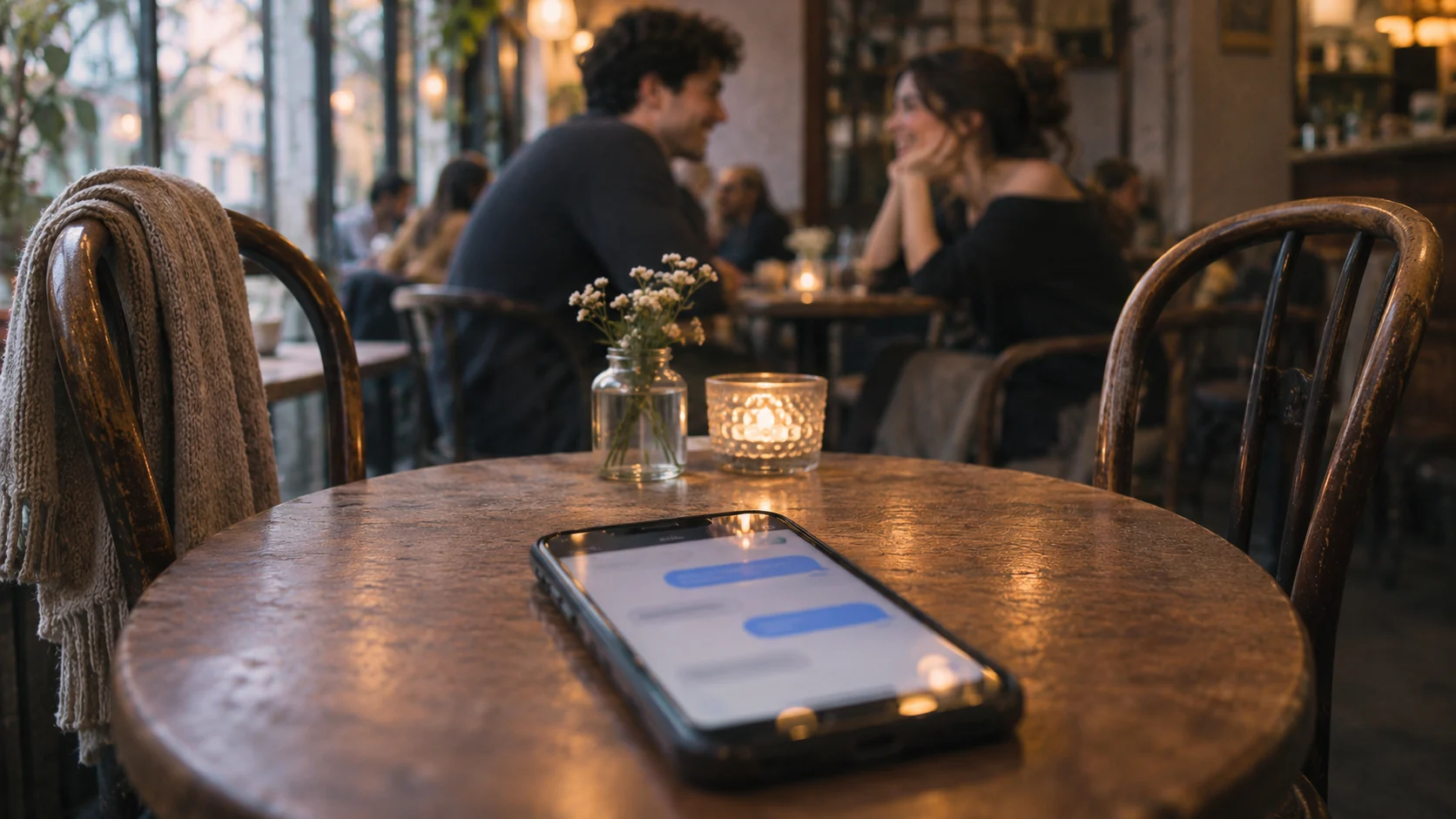
You match with someone on a dating app. The conversation is great. They’re funny, responsive, maybe a little flirtatious.
You exchange messages throughout the day. You develop inside jokes. You start looking forward to seeing their name appear on your phone.
After a week or two, you finally meet. And almost immediately, something feels off.
Nobody’s necessarily done anything wrong. They’re not a bad person. They’re just not quite the person you’d imagined. The chemistry that seemed so obvious through your phone has somehow disappeared between the front door and the first round of drinks. Or maybe it was never really there.
You’re Not Just Getting to Know Someone. You’re Inventing Them.
One of the stranger things about getting to know someone through text is how much information your brain has to fill in.
You don’t hear their voice. You don’t see how they react to something unexpected. You can’t tell whether their humour is dry, playful, sarcastic or delivered with a straight face. So you fill in the blanks.
When someone sends a clever message, you imagine how they’d say it. When they’re affectionate, you imagine what spending time with them might feel like. The longer the conversation continues, the more elaborate that mental picture can become.
You might genuinely enjoy talking to this person. But enjoying someone’s messages isn’t quite the same thing as enjoying their company. Texting chemistry is real in the sense that you’re experiencing something. It just isn’t necessarily evidence of real-world chemistry.
Dating Apps Reward People Who Are Good at Dating Apps
Being good at dating apps is a skill of its own. You need decent photos, an appealing profile, an interesting opening message and enough conversational ability to keep a stranger engaged without actually being in the same room.
Some people are naturally good at this. Others aren’t. But I don’t think being good at messaging strangers has much to do with being a good romantic partner.
I’ve known genuinely interesting, funny, socially confident people who struggled on dating apps. Not because they had nothing to offer, but because the things that made them appealing were much more obvious in person.
Someone can be terrible at clever responses on a Tuesday afternoon and be wonderful company over dinner. The reverse is equally possible. Yet we often evaluate people on the first skill before giving them a chance to demonstrate the second.
The Endless Almost-Date
There’s another problem with all this messaging: it creates an enormous amount of activity that can feel like progress without necessarily leading anywhere.
You match. You chat. You exchange Instagram accounts. Now you’re watching each other’s stories. Maybe you occasionally react to something they post. Congratulations. You’ve acquired another person whose vacation photos you’ll be viewing for the next eighteen months.
I’ve done this myself, so I’m not judging. Sometimes people aren’t particularly motivated to date. They’re bored, curious or enjoying a little validation. Nothing inherently wrong with that.
But when one person genuinely wants to meet and the other is essentially browsing, the mismatch in intention can be frustrating. Expressing interest has become so easy that it doesn’t always mean much. A swipe requires almost nothing. Making a plan requires a little more.
A Date Tells You Things a Profile Can’t
Imagine two people you’re considering meeting. One has an excellent profile and sends consistently entertaining messages. The other suggests checking out a new café, visiting a gallery or exploring a part of the city you’ve never been to.
That suggestion tells you something. Maybe they have interesting taste. Maybe they’re curious. Maybe they’re comfortable taking initiative. You already know a little about how they enjoy spending their time.
And once you meet, you learn things that are hard to communicate through even the most carefully constructed profile. How do they treat the server? Do they ask questions? Can they laugh at themselves? Is conversation comfortable, or does it feel like you’re interviewing for a position neither of you particularly wants?
I’m Not Suggesting You Meet Every Stranger Immediately
Some messaging before a date is sensible. People need to establish basic comfort, discuss boundaries, make sure they’re looking for compatible things and assess whether meeting feels safe. No one should feel pressured into meeting someone before they’re ready.
My argument isn’t that texting is useless. It’s that we’ve started treating prolonged texting as a reliable substitute for meeting, when the two experiences reveal different things.
What If We Reversed the Order?
This question was part of what led me to help create Bambi, a dating app built around proposing an actual date before matching.
Instead of matching first and figuring out what to do later, someone puts forward a plan: coffee on Saturday, a walk in the park, drinks at a particular bar. Other people express interest in that plan.
You’re not just saying, “I might be interested in you.” You’re saying, “Here’s something I’d actually like to do.” There’s no guarantee of chemistry, but at least the interaction begins with the possibility of a real experience.
The Three-Minute Test
I don’t think there’s a way to predict romantic chemistry with complete accuracy. Not through photos, personality questionnaires, compatibility algorithms or weeks of carefully composed messages.
Sometimes you just have to meet. You may discover within three minutes that it’s not going anywhere. That might sound disappointing, but I’d argue it’s better to find out after a short coffee than after two weeks of building an elaborate relationship with someone who only really existed in your imagination.
At least you got out of the house.